While Bitcoin continues to struggle to find direction, plaintiffs yesterday filed a motion in the US District Court for the Southern District of New York that reveals a far more detailed picture than a mere request to transfer frozen funds; behind the filing lies a story about how cryptocurrency became a tool for sanctions evasion and how the US judicial system is trying to stop it.
The case concerns 344,149,759 USDT held on two Tron network wallets that belong to the Islamic Revolutionary Guard Corps, and OFAC added those addresses to the sanctions list on April 24, 2026; Tether immediately froze the balances, making the tokens non-transferable. The technical mechanics matter here: the USDT smart contract contains built?in functions named "blacklist" to freeze an address and "destroyBlackFunds" to zero out a balance. In other words, Tether built infrastructure from the outset that enables centralized control over an ostensibly decentralized asset.
As the complaint notes, the plaintiffs — survivors of Iran-sponsored terrorist attacks — have won judgments against Iran totaling more than $2.4 billion over the past 25 years: $552 million in compensatory awards and nearly $1.9 billion in punitive damages. Iran paid not a penny. Evidently, they now seek to enforce those judgments through the IRGC's crypto wallets.
The plaintiffs' central argument is simple and persuasive: Tether already complied with government requests to move or neutralize USDT. In March 2025, at the FBI's request, the company transferred an equivalent USDT amount to US authorities. In November 2024, under an Ohio court order, Tether "burned" tokens at a target address and reissued 4,340,000 USDT to a law-enforcement-controlled wallet.
That history raises the question: if Tether acted at the government's request, must the company also act for private creditors who hold court judgments?
The filing also provides important context about Tether itself. As of April 2026, the company froze more than 4.4 billion USDT in total. Tether's USDT reserves exceeding $181 billion sit 99% with Cantor Fitzgerald, whose headquarters are in New York — a fact that helps justify this court's jurisdiction. The filing also recounts an allegation that a Tether employee once demanded a "20% fee" to reissue frozen tokens to another owner, which underscores the technical feasibility of such operations.
I note that this lawsuit raises a fundamental question for the entire stablecoin sector: how centralized is this market in practice, and under what circumstances can private claimants force an issuer to reallocate assets? If the court sides with the plaintiffs, it will create a precedent capable of changing the legal status of stablecoins in the US. USDT would then become not only a digital dollar substitute but also an asset subject to civil enforcement, analogous to a bank account.
Trading recommendations:
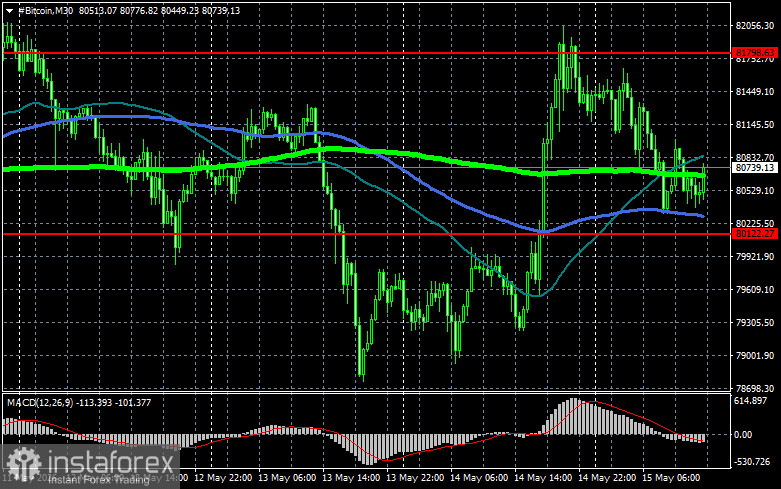
Regarding Bitcoin's technical picture, buyers now target a return to $81,800, which opens a direct road to $83,600, and from there the market would be within reach of $85,600. The most distant target stands at the high near $87,900, and a breach of that level would signal attempts to restore the bull market. In case of a Bitcoin decline, I expect buyers at $80,100. A return of the instrument below that area could quickly push BTC toward $78,300. The furthest downside target would be the $76,300 area.
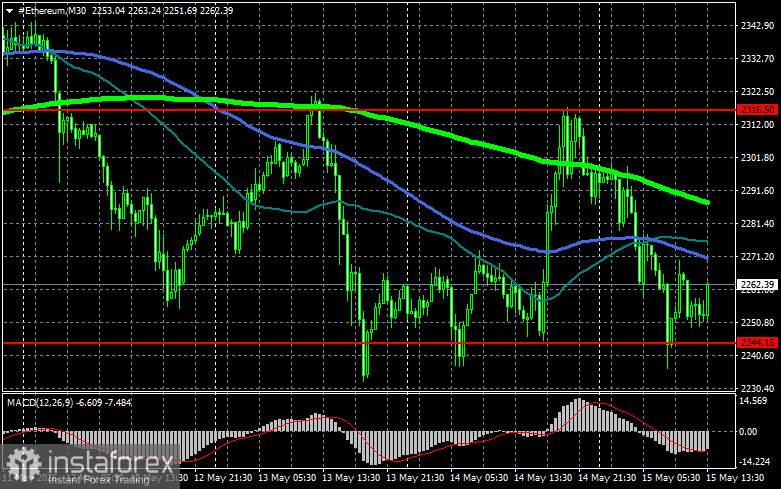
Regarding Ethereum's technical picture, a clear consolidation above $2,316 opens a direct road to $2,373. The most distant target stands at the high near $2,446, and a breach of that level would indicate strengthening bullish sentiment and a return of buyer interest. In case of an Ether decline, I expect buyers at $2,244. A return of the instrument below that area could quickly push ETH toward $2,181. The furthest downside target would be the $2,114 area.
What we see on the chart:
- Red lines indicate support and resistance levels where either a price slowdown or active growth is expected;
- Green lines indicate the 50-day moving average;
- Blue lines indicate the 100-day moving average;
- Light green lines indicate the 200-day moving average.
A crossover, or a price test of moving averages, typically either halts the move or sparks fresh market momentum.